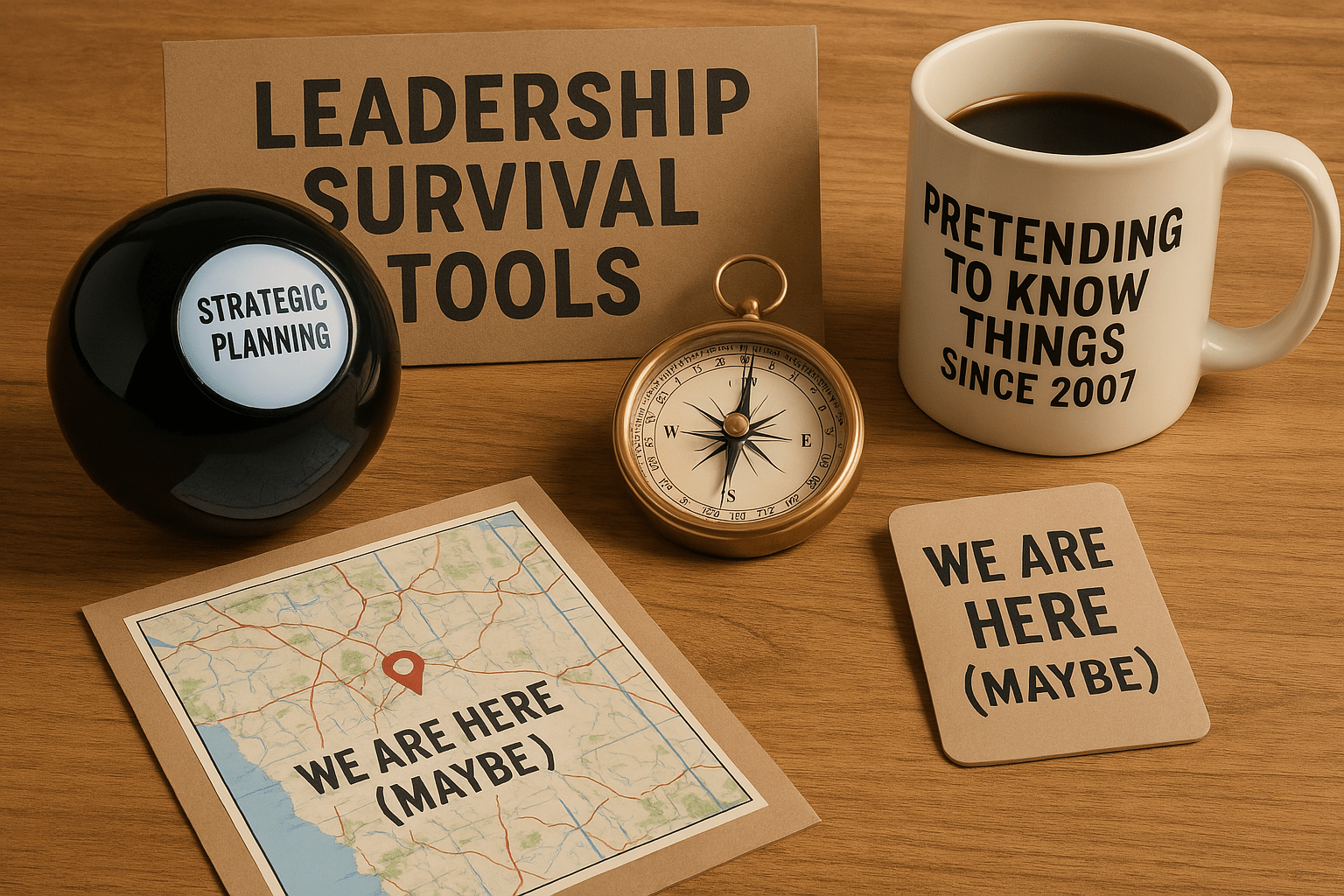
Let’s get real for a moment. There’s this persistent myth that leaders are supposed to have all the answers. That somewhere between your last promotion and your first leadership off-site, the universe downloads a comprehensive database of solutions directly into your brain.
Spoiler alert: It doesn’t. And I have the awkward meeting silences to prove it.
After years of leadership roles where I’ve had to make decisions during a global pandemic (still have the stress-purchased exercise equipment to prove it), navigate an acquisition where the only certainty was uncertainty, and guide clients through organizational transformations that resembled controlled demolitions, I’ve developed what I’m calling my “Leading While Clueless” survival toolkit.
The Moment I Realized I Was Winging It (And Everyone Else Was Too)
Picture this: I’m sitting in a boardroom with senior executives, nodding thoughtfully at complex financial projections. Someone turns to me and asks, “What do you think about these forecasting assumptions?”
My internal monologue: “I think I should have paid more attention in that MBA finance class instead of planning my weekend.”
What I actually said: “I’d like to hear more about the methodology behind these numbers before weighing in.”
That day, I realized something powerful. The pause that followed wasn’t disappointment in my lack of immediate insight. It was relief. Relief that someone was willing to slow down and question rather than pretend to comprehend.
The Liberating Power of “I Don’t Know”
There’s this strange paradox in leadership. We climb the ladder by demonstrating competence, then find ourselves in situations where admitting incompetence becomes our most valuable skill.
When our company was undergoing restructuring, I started an all-hands meeting with words I’d previously considered leadership suicide: “I honestly don’t have clarity on exactly how this will unfold.”
The response? Not the revolt I expected. Instead, shoulders relaxed. Someone actually sighed with relief. Turns out, people can handle uncertainty. What they can’t handle is the cognitive dissonance of being told everything’s fine when their reality suggests otherwise.
I’ve since become an evangelist for what I call “intellectual honesty” in leadership. Some practical ways this plays out:
- Starting strategic discussions with “Here’s what we know, here’s what we don’t know, and here’s how we’re approaching the gap”
- Replacing “We’ll definitely hit our targets” with “Here’s our current probability assessment, and the factors that could shift it”
- Responding to impossible questions with “That’s an excellent question that I can’t answer right now. Here’s when and how I’ll get back to you.”
The strangest outcome? My credibility went up, not down.
Creating Certainty Containers in Uncertain Times
When everything feels like it’s shifting, people need something solid to hold onto. I call these “certainty containers” – small, defined spaces of predictability amid chaos.
During our acquisition, when rumors were spreading faster than that office cold everyone gets in December, I instituted daily 15-minute stand-ups. The content of these meetings changed daily, but their existence was constant. People could count on that touchpoint regardless of what else was happening.
Other certainty containers I’ve used:
- Weekly “What We Know Now” email updates during organizational changes
- “Question collection hours” where anyone could submit anonymous concerns
- “Certainty Circles” – an exercise where teams identify what’s in their control, what’s in their influence, and what’s outside both
The magic isn’t in having answers. It’s in creating predictable spaces where questions can safely exist.
The Art of the Strategic Deflection
Some of my most valuable leadership moments haven’t involved providing answers at all, but rather redirecting questions back to the asker.
I once had a team member come to me with an elaborate problem regarding a client project. After listening intently, I asked, “What do YOU think we should do?”
The solution she proceeded to outline was significantly better than anything I would have suggested. She had been living with the problem daily. She just needed permission to trust her judgment.
I’ve since refined this approach to avoid it feeling like a lazy leadership cop-out:
- “Before I share my thoughts, I’d love to hear your perspective since you’re closer to this.”
- “I have some initial ideas, but I’m concerned they might not account for X factor that you understand better than I do.”
- “Let’s think through this together. What options have you considered so far?”
This approach accomplishes two things: it often yields better solutions AND it builds decision-making confidence in your team.
From Answers to Attention: The Real Leadership Currency
Perhaps the most profound realization in my leadership journey is this: what people actually want from leaders isn’t omniscience. It’s attention.
During a particularly chaotic quarter, I was agonizing over a strategic decision. I’d created spreadsheets, consulted experts, and lost sleep trying to calculate the perfect path forward. Meanwhile, my team seemed increasingly anxious.
When I finally sat down with them, I realized something humbling: they weren’t waiting for my perfect decision. They were waiting for evidence that I was thinking about the problem at all. They wanted to know the issue was on my radar, that I cared about the outcome, and that I was applying thoughtful consideration.
This shifted my approach entirely. Instead of disappearing into my office to emerge with stone tablets of wisdom, I started narrating my thinking process:
- “Here’s what I’m considering…”
- “These are the factors I’m weighing…”
- “This is the information I’m still seeking…”
The transparency wasn’t just reassuring to the team; it also invited their insights into my decision process, ultimately leading to better outcomes.
Embracing Vulnerability as Strategic Strength
I used to think vulnerability was leadership kryptonite. Now I see it as a superpower.
During one client’s organizational overhaul, I started our kick-off meeting with a confession: “I’ve led three similar transformations before, but each one taught me that no two are alike. So while I bring experience, I don’t bring certainty. We’ll be learning this organization’s unique needs together.”
That admission set the tone for a collaborative process rather than a prescribed one. It invited the client into partnership rather than positioning me as the all-knowing consultant with a cookie-cutter solution.
My favorite email signature during times of uncertainty has become: “Figuring it out alongside you.” Those six words have generated more positive feedback than any brilliant strategy I’ve ever outlined.
The Unspoken Truth: Everyone’s Making It Up As They Go
Here’s the liberating secret I wish someone had told me earlier in my leadership journey: everyone is improvising to some degree. Even the most prepared, most experienced, most confident-seeming leaders are making judgment calls based on incomplete information.
The difference isn’t who has all the answers. It’s who can create enough psychological safety for the team to function effectively while searching for answers together.
Next time you’re in a situation where you feel the crushing weight of needing to have all the solutions, try this reframe: Your job isn’t to know everything. Your job is to create the conditions where the best thinking can emerge – whether that’s from you or someone else.
And sometimes, the most powerful leadership tool is simply saying, “I don’t know yet. Let’s figure it out together.”
What’s been your experience leading through uncertainty? I’d love to hear your stories, strategies, and yes, even your epic failures turned learning moments. After all, we’re all just figuring it out as we go.
P.S. If you’re wondering if I ever actually Googled answers under the table during important meetings… well, let’s just say screen brightness settings exist for a reason.

