If you signed a venue contract before you defined your program goals, you planned your event backward.
It happens more often than most organizations want to admit. And it costs more than most organizations realize.
Why Venue-First Planning Fails
There is a very common sequence that plays out in event planning across industries.
Someone books the dates. Someone else selects the venue. A planning committee forms. An agenda gets drafted. And eventually, someone asks the question that should have come first: “What are we trying to accomplish?”
By that point, the answer barely matters. The decisions have already been made.
I’ve been in planning meetings where the venue was locked before anyone could clearly explain the program’s goal.
Venue-first planning locks you into constraints before you understand your needs. It means your program design is shaped by the space instead of the strategy. It means your agenda is built around what fits the room instead of what serves your audience.
And the results reflect it. Attendees leave underwhelmed. Leadership is frustrated. The event runs fine, but delivers little. And the planning team is already dreading next year.
What Strategy-First Planning Actually Looks Like
Strategy-first planning starts with a question, not a contract.
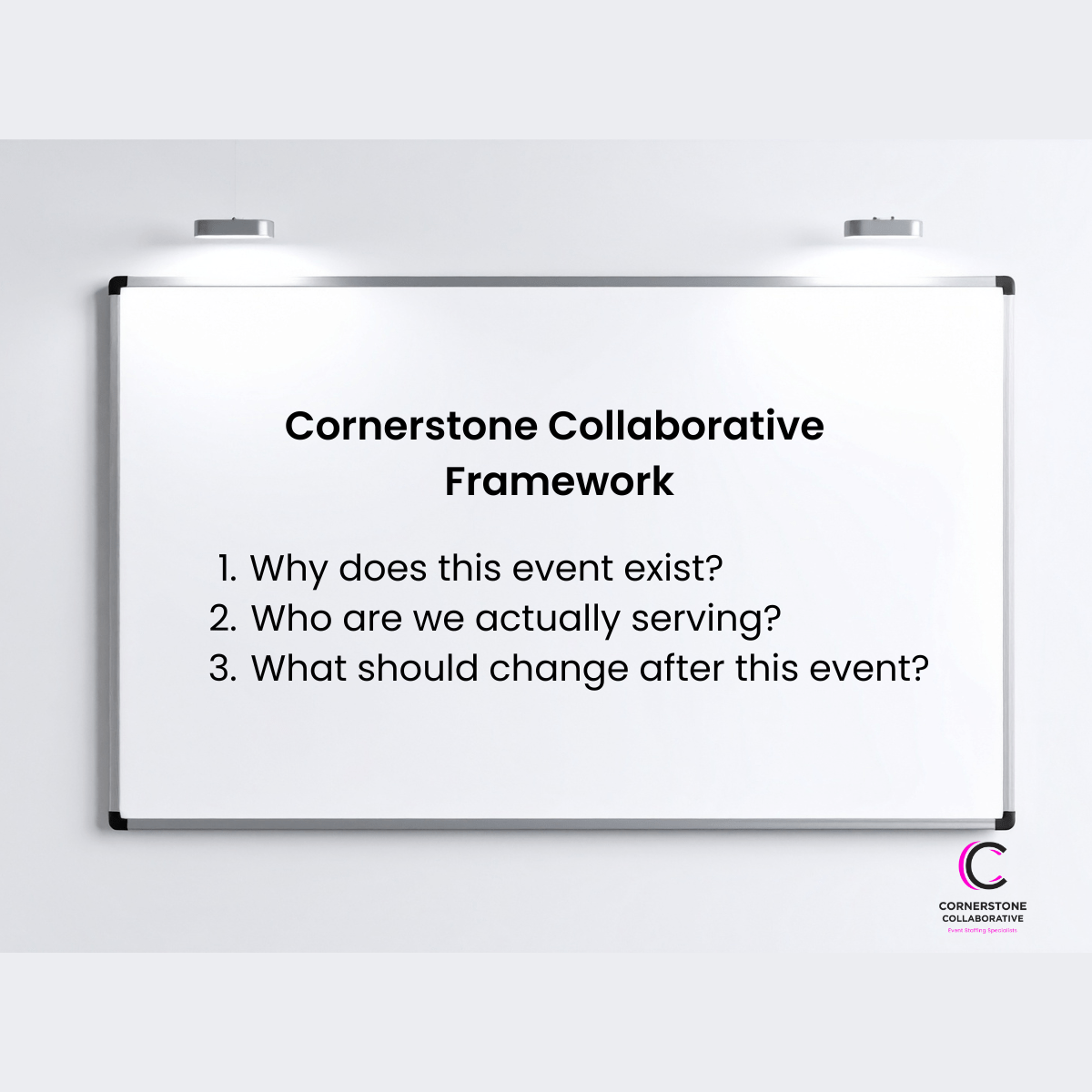
Before Cornerstone Collaborative touches a venue search, we walk every client through three foundational questions. These are part of what I call the Clarity-First Event Framework, and they shape every decision that follows.
What does success look like the day after the program ends?
Not during the event. After. When the room is cleared and everyone is back at their desks, what should be different?
Who is this meeting truly designed to serve?
Not just who is attending, but whose experience has to be exceptional for the event to be considered a win. Is it your top donors? Your newest members? Your executive leadership team? The answer shapes every room setup, every session format, every networking moment.
What would make this program worth telling someone about?
This one is harder than it sounds. But the organizations that can answer it clearly are the ones that plan events people actually remember.
These questions are not just helpful to know. They are the foundation of every logistics decision that follows.
How Strategy Shapes Logistics
Here is where it gets practical.
Once you know your goals, logistics become clearer. The right venue is not the one with the best rate or the most convenient location. It is the one that serves your objectives.
A program designed to deepen member connection needs different spaces than one designed to train a large staff cohort. A meeting built around presenting a vision to stakeholders looks and feels different from one built to create alignment among team leads.
When strategy comes first, your room sets, session formats, technology choices, food and beverage, and even your general session AV all point toward the same goal.
When logistics come first, all of those elements are just there. Present but not purposeful.
The Real Cost of Planning Backward
Organizations that lead with logistics before strategy pay for it in ways that do not always appear on the budget sheet.
They pay in low engagement. When the program is not aligned with what attendees actually need, the energy in the room reflects it. People check their phones. Conversations feel forced. The closing session ends with polite applause instead of momentum.
They pay in missed opportunities. A well-designed meeting is one of the most powerful alignment tools an organization has. When it is treated as a production instead of a strategy, that opportunity is wasted.
They pay in repeat frustration. The planning team worked hard. The event looked great. But no one can quite explain why it did not feel like a success. So next year, they try to fix it with a nicer venue or a bigger keynote budget. And the cycle continues.
The Shift That Changes Everything
The good news is that this is a fixable problem. And the fix does not require more money.
It requires starting with outcomes before you start with options.
Before the venue search. Before the RFP. Before the first site visit. Sit down with your stakeholders and define what this program is supposed to do. Write it down. Agree on it. Use that definition as the filter for every decision that follows.
That is strategy-first planning. It is not complicated. But it is intentional. And intention is what separates events that work from events that just happen to occur on the calendar.
The Cornerstone Approach
At Cornerstone Collaborative, we build every engagement around this principle. Our planning process always starts with a strategic alignment conversation before any logistics are touched.
We ask the hard questions up front so the right answers are already in place when the decisions need to be made.
I remember early in my career grabbing a Dr. Pepper and sitting across from a client who had already signed the hotel contract, booked the AV company, and printed the save-the-dates. They came to us because something felt “off” about the whole plan. It took about twenty minutes of the right questions to find the issue: nobody had ever agreed on what the program was actually supposed to accomplish. The logistics were locked. The strategy was missing entirely.
We made it work. But it would have been a completely different event if those questions had come first.
If you are planning a program and are not sure where to start, start with the questions. Not the contract.
The venue will still be there when you are ready. But the strategy needs to come first.
Final Thought
What is the first question you ask before planning a meeting or large program? Share it in the comments below.
 #meetingplannerproblems